Stanford’s New Course: Vibe Coding
In Silicon Valley, a self-deprecating joke is becoming reality. While many are still struggling with coding errors, Stanford has officially announced a course teaching ‘Vibe Coding’.
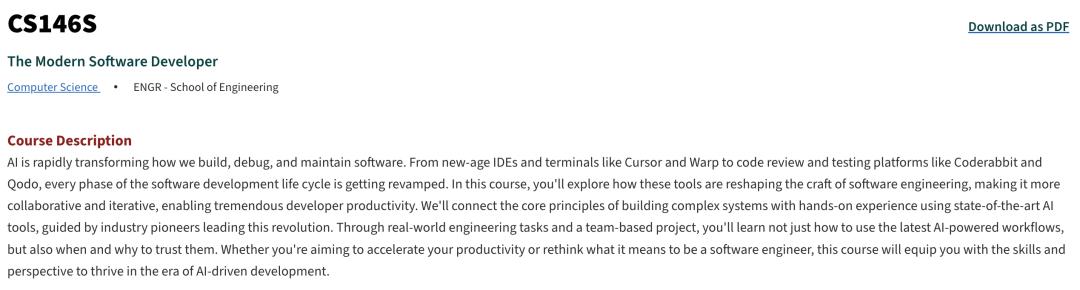
Recently, Stanford’s Computer Science Department launched a course titled CS146S: The Modern Software Developer. This course does not teach you how to write red-black trees or wrestle with assembly language; its sole mission is to transform you from a “code writer” into a super individual who can command AI to produce and manage complex systems.
After reviewing the course outline, one can’t help but marvel at how the underlying logic of software engineering has shifted.

What is Vibe Coding?
Vibe Coding describes an extremely smooth development state: developers no longer type out logic line by line but instead command AI through high-quality dialogues (prompting) to generate thousands of lines of code in an instant.
Many might think this is just being a “high-level package user”. Can this even be taught at Stanford?
The course description for CS146S elevates this perception: “From IDE to terminal, from testing platforms to operational monitoring, every stage of the software development lifecycle is being reshaped.” The core goal of this course is not to make you code faster but to teach you two key things:
- Make AI a controllable, reusable, and auditable ’engineering teammate’: rather than a black box that might spout nonsense at any moment.
- Ensure quality standards under the premise of AI generating code: ensuring that the generated products not only run but are also safe, robust, and capable of generating revenue for the company.
10-Week Intensive Training: From ‘Keyboard Warrior’ to ‘AI Manager’
The pace of this course is rapid, overturning traditional programming perceptions each week. Here’s a breakdown of the course’s six core stages:
Stage 1: From Mysticism to Science (Week 1–2)
Many students believe writing prompts is purely luck, but Stanford teaches you to prove it through experimentation.
Core Focus: Coding LLM and MCP. The emphasis shifts from prompt techniques to Model Context Protocol (MCP)—equipping AI with standardized “hands” and “eyes” to legally call external tools.
Stage 2: Context Engineering is the Primary Productivity (Week 3–4)
If you complain that AI fails to write long code, it’s because you don’t know how to “feed it properly”.
New Mantra: “Specs are the new source code”.
Practical Application: Directly engage with Claude Code. Your training goal shifts from being a keyboard warrior to an Agent Manager. You must learn to write constraints and rules for AI, rather than just hitting “retry”.
Stage 3: AI Takes Over the Command Line (Week 5)
Using just a cursor is outdated. Stanford teaches you to use AI terminals like Warp to handle system tasks. IDEs are for writing, while terminals are for executing and managing.
Stage 4: Security is the Main Course (Week 6–7)
This is a pivotal point in the course. Stanford has invited the CEO of Semgrep to oversee.
Hard Warning: Beware of Prompt Injection leading to Remote Code Execution (RCE).
Reality Check: The more AI generates, the more important verification and protection become.
Stages 5 and 6: Not Only Create but Also Maintain (Week 8–9)
This part is particularly valuable. Many learn AI coding just to produce demos, but Stanford has thought through what happens post-deployment: monitoring, observability, and automated fault response. This course extends AI into On-call and DevOps scenarios, training high-level talent capable of managing the entire loop.
The High Bar for Entry: You Can’t Just ‘Vibe’ Your Way In
After reviewing this outline, you might think, “I don’t need to learn programming; I can just vibe at Stanford.”
Naive.
Take a look at the prerequisites listed on Stanford’s official website, which are enough to deter novices:
- Foundational Knowledge: It is strongly recommended to complete CS111 (Operating Systems) first.
- Design Experience: A deep understanding of complex software design, open-source projects, and GitHub is required.
- AI Theory: Completion of CS221 (Artificial Intelligence) or CS229 (Machine Learning) is suggested.
What does this mean?
It means Stanford believes that someone who doesn’t understand operating systems, memory allocation, or has never written complex code is not qualified to discuss ‘Vibe Coding’. When directing a group of AI agents, if you don’t understand distributed architecture, you cannot discern whether the AI is providing a “brilliant solution” or a “deadly trap”. AI lowers the barrier for ‘brick-moving’, but it significantly raises the bar for ‘commanders’.
Three Job Market Insights from Stanford
For international students job hunting in the U.S., facing layoffs at Meta and Google, this course reveals three harsh but real signals:
-
The ‘Coder’ is Dying, and the ‘Architect’ is Delegated Programmers who only implement functions are becoming undervalued. Major companies now need individuals who can define problems (Write Spec) and design processes (Design Agent Workflow).
-
Security and Testing are the New ‘Iron Rice Bowl’ Since AI-generated code is overflowing, those who can perform “code audits” and “threat modeling” will be the bedrock of companies.
-
Reconstruction of Full-Stack Definition Previously, full-stack meant Front-end + Back-end; now it encompasses everything from Prompt to Agent to automated operations.

Don’t Just Be a ‘Brick Mover’ in the Best of Times
Stanford’s course once again reminds us:
In this era, the iteration of tools is rapid, but the essence of engineering—quality, security, and maintainability—remains unchanged.
CS146S is not teaching students to “cut corners”; it is teaching them how to remain responsible for system outcomes in an age where AI is ubiquitous.
The barrier for “being able to code” is disappearing, while the ability to “define problems, master AI, and take responsibility for system outcomes” is becoming increasingly valuable.
So, the question arises: Are you ready to transition from a ‘coder’ to an elegant ‘AI shepherd’ in the face of AI’s relentless advance?


Comments
Discussion is powered by Giscus (GitHub Discussions). Add
repo,repoID,category, andcategoryIDunder[params.comments.giscus]inhugo.tomlusing the values from the Giscus setup tool.